
Product Details
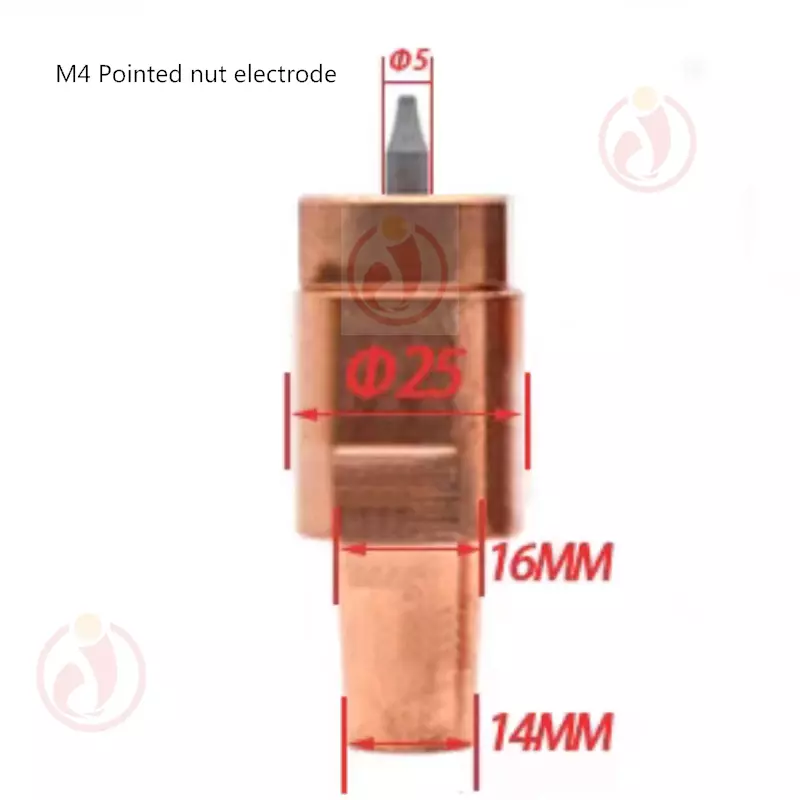
M4 Pointed Nut Electrode | High-Precision Welding Electrode for Pointed Nut
Product Overview
Guangzhou Jiahe Automation Equipment Co., Ltd. M4 Pointed Nut Electrode is a professional precision resistance welding accessory, exclusively developed for the efficient and stable welding of M4 pointed nuts in automated production lines. It integrates targeted pointed nut structural design, high-grade alloy materials and advanced machining technology, aiming to solve the common pain points of pointed nut misalignment, unstable welding quality, uneven current distribution and low efficiency in traditional pointed nut welding processes. As a core product in our pointed nut welding electrode series, this electrode is independently R&D and manufactured, perfectly matching M4 pointed nut specifications (Φ d=4mm for standard models), and delivering consistent, high-strength and neat welding results for large-volume industrial manufacturing scenarios. It is particularly designed to address the challenges of welding small-size M4 pointed nuts, where precise positioning, concentrated current transmission and stable force application are critical to avoid nut slipping, tip damage and ensure firm, seamless bonding, especially for workpieces requiring accurate alignment and smooth welding joints. Compared with ordinary electrodes, it features a more fitted pointed cavity design, which effectively concentrates welding current, improves welding stability and reduces the defect rate caused by poor fitting.
Tailored specifically for M4 pointed nut welding, our electrode features a precision-machined positioning structure with a matching pointed cavity, which perfectly fits the shape and size of M4 pointed nuts (with standard thread specification of M4×0.7 for coarse thread and M4×0.5 for fine thread, and standard pointed tip angle of 60° superscript:1), ensuring accurate centering during welding, avoiding deviation, tilting or slipping, and ensuring firm bonding between the nut and the workpiece. It is fully compatible with mainstream projection welding, spot welding and nut welding equipment at home and abroad, and is widely used in high-volume production fields such as automotive manufacturing, hardware processing, sheet metal fabrication, precision machinery and electrical equipment. With excellent electrical conductivity, superior wear resistance, strict dimensional accuracy and long service life, it has become the preferred choice for M4 pointed nut automated welding, helping customers improve production efficiency and reduce defective product rates significantly, especially for workpieces with high positioning accuracy requirements. It is also suitable for welding M4 pointed nuts with different surface treatments such as environmental trivalent chromium, Dacromet, chromium-free Dacromet, galvanized and black oxide.
Premium Material & Advanced Manufacturing Process
Adhering to the production principle of "Materials as the foundation, technology as the core, and quality as the life", we select high-performance alloy materials for our M4 Pointed Nut Electrode, mainly including chromium zirconium copper (CrZrCu, CuCrZr), RWMA Class 2 (C18200) copper-chromium alloy, and optional alumina copper (CuAl₂O₃) for special working conditions — materials highly recommended for high-volume, high-frequency nut welding operations, especially suitable for welding M4 pointed nuts with hot or cold rolled steels, galvanized and coated materials, as well as high-strength steels. All raw materials undergo strict incoming inspection, including purity testing and performance verification, to ensure stable electrical conductivity (≥85% IACS for CrZrCu), strong heat resistance and excellent mechanical properties (HRB 75-85 for CrZrCu), laying a solid foundation for the electrode's long-term stable operation. For scenarios requiring welding of galvanized plates, the optional alumina copper material effectively avoids electrode sticking to the workpiece, reducing the need for frequent grinding and improving production efficiency. For welding of copper alloys and brass, we can also provide electrodes made of ECuSi or ECuSnB materials to ensure excellent welding performance and corrosion resistance; for high-precision pointed contact surface processing, we also adopt tungsten alloy materials in some models, leveraging their high temperature resistance and good conductivity to protect the pointed structure from deformation during welding. Additionally, nickel (Ni) alloy materials can be selected for special electronic component welding scenarios, taking advantage of Ni's high melting point (1453℃) and excellent high-frequency performance.
Our M4 Pointed Nut Electrode adopts an integrated manufacturing process of cold extrusion forming, high-precision CNC machining, professional heat treatment and fine surface polishing. We adopt advanced cold-forming technology that retains the original hardness of the material, ensuring the overall structural integrity and high structural strength of the electrode, effectively avoiding fracture, deformation or wear under high-frequency welding pressure and high-temperature working conditions. The pointed positioning cavity of the electrode is precisely machined according to M4 pointed nut specifications (with standard pointed tip angle of 60° and thread specifications M4×0.7 for coarse thread, M4×0.5 for fine thread superscript:1), with a pin diameter that can be customized in 0.1mm increments (ranging from 2.8mm to 5.0mm) to match different nut inner hole sizes, ensuring tight fit and accurate centering. The pointed welding surface is polished to a high finish, with smooth edge treatment to avoid edge discharge, concentrate current distribution and prevent welding spatter, ensuring neat welding seams. Strict tolerance control (±0.005~±0.01mm) is implemented throughout the production process, and every finished product undergoes comprehensive quality inspection, including dimensional accuracy testing, conductivity detection, wear resistance verification and surface defect inspection, to ensure zero defects before delivery. Some models are equipped with a refractory metal face (RWMA Class 11, 75% tungsten, 25% copper) brazed onto the base material, suitable for welding at higher pressure and heat common with projection welding. Standard models feature a pin diameter of 0.110~0.118 inches, overall length of 0.6~1.8 inches and weld face diameter of 0.276~0.472 inches, compatible with mainstream welding equipment and M4 pointed nut specifications. The pointed contact surface is processed with ultra-precise grinding technology, ensuring tight contact with the pointed nut surface to achieve concentrated current distribution and stable welding effect, which is particularly suitable for the resistance welding principle requiring concentrated heat generation, and also conforms to the welding characteristics of pointed nuts that require stable positioning and focused force application.
Core Product Advantages
1. Targeted Design for M4 Pointed Nut
The electrode is specially designed for M4 pointed nut specifications, with a precision positioning pin and matching pointed cavity structure that perfectly fits the M4 pointed nut's shape and size (including standard thread M4×0.7 for coarse thread, M4×0.5 for fine thread and pointed tip angle 60° superscript:1). The pointed cavity is precisely machined to match the tapered surface of M4 pointed nuts, ensuring accurate centering of the pointed nut during welding, effectively avoiding misalignment, tilting or slipping, and ensuring that the welding point is evenly stressed and current is concentrated on the pointed contact surface. It solves the problem of unstable welding quality caused by nut deviation and tip damage in traditional welding, and greatly improves the qualification rate of welded products, especially suitable for high-standard automated production lines. The smooth edge treatment of the electrode also enhances mechanical strength by dispersing stress, avoiding metal fatigue, fracture and edge wear, which is crucial for the stable welding of small-size M4 pointed nuts. Some models are equipped with a spring-loaded insulated pilot that retracts when in contact with the upper electrode, preventing damage to the pointed welding surface during the welding process, which is particularly important for maintaining the integrity of the pointed contact surface.
2. Excellent Conductivity & Efficient Heat Dissipation
Made of high-performance copper alloy materials, the M4 Pointed Nut Electrode features superior electrical and thermal conductivity, which can quickly transfer current and heat to the welding contact point, concentrate current on the pointed surface, reduce energy loss and avoid overheating of the electrode during long-term high-frequency welding operations. CrZrCu material, as the preferred material for high-end welding electrodes, ensures stable conductivity and heat dissipation, with a recrystallization temperature of up to 500℃, maintaining high strength even under long-term high-temperature operation. Some models are equipped with built-in water cooling channels, which further improves heat dissipation efficiency, prolongs the service life of the electrode, and enables it to outperform cast or forged electrodes with similar structures in terms of durability and stability. The optional alumina copper material also provides excellent high-temperature mechanical properties, with a softening temperature of up to 900℃, ensuring stable performance under extreme working conditions and effectively solving the problem of electrode sticking when welding galvanized plates. For welding scenarios involving magnesium alloys, the electrode can also be optimized to adapt to the electrochemical characteristics of magnesium alloys, ensuring stable welding quality; the optional tungsten alloy pointed contact surface further enhances high-temperature resistance, preventing the pointed structure from deformation during high-heat welding, and the optional nickel alloy material is suitable for high-frequency electronic component welding scenarios.
3. Ultra-High Dimensional Precision & Stable Assembly
Adopting high-precision CNC machining and strict quality control system, all dimensions of the M4 Pointed Nut Electrode (including overall length, pin diameter, positioning cavity size, pointed tip angle and taper) meet international standards (GB, DIN, ISO, ANSI) and can be perfectly matched with standard welding equipment (mounting via 5/8-18 threads for most models). The pin diameter for M4 pointed nuts can be customized in 0.1mm increments, ranging from 2.8mm to 5.0mm, to adapt to different nut inner hole requirements, which is consistent with the standard nut inner hole design principle and M4 pointed nut specifications. Standard models have an overall length of 0.6~1.8 inches, a pilot diameter of 0.110~0.118 inches and a weld face diameter of 0.276~0.472 inches, compatible with mainstream welding equipment and M4 pointed nut specifications (Φ d=4mm, pointed tip angle 60° superscript:1). High dimensional consistency ensures stable assembly with welding equipment, avoids loose connection or misalignment during welding, and guarantees consistent welding quality, fully adapting to high-speed automated welding production lines. The strict tolerance control also ensures that the pointed cavity fits tightly with the nut surface, preventing welding deviation and ensuring uniform force application during welding, which is essential for maintaining stable welding current and forming qualified weld nuclei, and also conforms to the high-precision requirements of M4 pointed nut welding in automated production.
4. Strong Customization Capability for Diversified Needs
We support full non-standard customization according to customer-provided drawings, samples and actual welding working conditions. Whether it is the pin diameter (customizable in 0.1mm increments for M4 nuts), overall length, positioning cavity size, pointed tip angle, the addition of water cooling channels, or the selection of special materials (such as alumina copper for galvanized plate welding, ECuSi/ECuSnB for copper alloy welding, tungsten alloy for high-temperature scenarios, nickel alloy for electronic component welding), our professional R&D and machining team can provide targeted solutions. We can also customize the electrode according to the specific M4 pointed nut model (coarse thread M4×0.7 or fine thread M4×0.5), welding equipment and workpiece materials (including magnesium alloys, copper alloys, electronic components, etc.), meeting the diversified and personalized welding needs of different industries. Customizable options also include refractory metal faces for high-pressure projection welding scenarios and spring-loaded insulated pilots for pointed surface damage prevention. For special pointed nut shapes or non-standard M4 pointed nuts, we can adjust the cavity design and pointed tip angle to ensure perfect fit, and also optimize the electrode structure with reference to precision positioning technologies such as double-head guide sleeves to improve welding accuracy, which is applicable to non-standard M4 pointed nut welding scenarios in various industries.
5. Long Service Life & High Cost-Effectiveness
The combination of premium alloy materials and advanced cold-forming manufacturing process greatly enhances the wear resistance, high-temperature oxidation resistance and impact resistance of the M4 Pointed Nut Electrode. CrZrCu material, with its excellent wear resistance (3-5 times that of pure copper), effectively extends the electrode's service life, and its high-temperature stability avoids softening and deformation during welding, which is a common problem of ordinary copper electrodes. The pointed contact surface, processed with high-precision grinding and reinforced by optional tungsten alloy or nickel alloy, is not easy to deform, wear or damage under long-term high-frequency welding operations, effectively extending the replacement cycle. This not only reduces production downtime and maintenance costs, but also lowers the overall production cost for customers, achieving high cost-effectiveness. The optional alumina copper material further extends the service life when welding galvanized plates by avoiding electrode sticking, while the refractory metal face enhances durability in high-pressure welding. Its durable performance also ensures stable welding quality in mass production, reducing the rate of defective products and improving production efficiency. For small-size M4 pointed nut welding scenarios, the electrode's compact design also helps reduce equipment space occupation and improve operation convenience, which is suitable for precision machining scenarios such as small-size part welding, narrow-space operation and electronic component welding, especially for M4 pointed nuts used in small-size fasteners and electronic components.
Wide Application Scenarios
Our M4 Pointed Nut Electrode is widely used in various automated resistance welding equipment, highly compatible with mainstream nut welding machines at home and abroad. It is specially designed for the welding of M4 pointed nuts, and its core application fields include:
-
Automotive manufacturing: Welding of M4 pointed nuts on auto body components, chassis, engine brackets, interior small parts and electronic components, suitable for high-volume automated production lines, ensuring firm bonding and consistent quality, especially for high-strength steel components and parts requiring accurate positioning. It is also applicable to welding of M4 pointed nuts on automotive parts with galvanized, Dacromet or black oxide surface treatment, and perfectly matches the assembly needs of automotive interior and exterior small parts, adapting to the high-efficiency production needs of the automotive industry, and also suitable for welding M4 pointed nuts in automotive electronic components.
-
Hardware & fastener industry: Precision welding of M4 pointed nuts on hardware tools, mechanical parts, small-size fasteners and electronic components (including M4 pointed nuts with standard thread M4×0.7 for coarse thread and M4×0.5 for fine thread), improving welding efficiency and product reliability, especially for products requiring precise positioning and smooth welding joints. It is also suitable for welding of fasteners with different surface treatments, meeting environmental protection and corrosion resistance requirements. The pointed design is particularly suitable for small-size fasteners and electronic components requiring concentrated current and stable welding in various industrial scenarios, and is compatible with standard M4 thread specifications.
-
Sheet metal fabrication: Welding of M4 pointed nuts on sheet metal components, cabinets, brackets and small-size sheet metal parts, adapting to the high-precision requirements of sheet metal welding, and avoiding nut slipping and tip damage during the welding process. For small-size sheet metal parts and narrow operation spaces, the electrode's compact design can better adapt to the working environment, and the pointed contact surface ensures concentrated current distribution and neat welding seams, which is in line with the characteristics of sheet metal spot welding operations, and also suitable for welding M4 pointed nuts on small-size sheet metal components.
-
General industrial manufacturing: High-standard resistance welding of M4 pointed nuts in high-volume production scenarios, such as electrical equipment, electronic components, construction machinery, instrumentation, railway accessories and shipbuilding interior small parts, ensuring stable welding performance and high weld strength, especially for workpieces with strict positioning requirements. It is also applicable to welding scenarios involving copper alloys, magnesium alloys and electronic components, expanding the application scope. The pointed design is also suitable for precision electronic component welding, where concentrated current and accurate positioning are required, and matches the assembly needs of instrumentation, electrical equipment and electronic components, taking advantage of the excellent performance of nickel alloy and tungsten alloy materials in electronic welding scenarios.
Why Choose Jiahe M4 Pointed Nut Electrode?
With more than 10 years of deep cultivation in the field of automated welding equipment and accessories, Guangzhou Jiahe is a national high-tech enterprise with a complete R&D, production and quality control system. Our M4 Pointed Nut Electrode inherits Jiahe's consistent quality concept, integrating professional design, premium materials and advanced technology. It is widely recognized by domestic and foreign customers for its reliable performance, precise dimensions, long service life and strong customization capability, establishing a good brand reputation in the global welding industry. We strictly control every link from raw material selection to production and inspection, ensuring that each electrode meets international standards (GB, DIN, ISO, ANSI) and customer requirements, especially for the precise processing of the pointed cavity which is the core of the product, and referring to advanced positioning technologies to improve welding accuracy. The high-precision pointed contact surface processing, combined with optional tungsten alloy or nickel alloy materials, ensures the electrode's stability in high-demand welding scenarios, and our material selection fully considers the characteristics of different welding workpieces, such as galvanized plates, high-strength steels and electronic components.
We provide one-stop after-sales service and technical support, responding quickly to customer needs such as product consultation, customization scheme design, installation guidance and after-sales maintenance. We are committed to becoming a reliable partner in the field of automatic welding, providing customers with cost-effective M4 Pointed Nut Electrode solutions and boosting the stability and efficiency of automated production lines, whether for standard M4 pointed nut welding or special material workpiece welding (such as copper alloys, magnesium alloys, electronic components).
Previous: M4 Round Nut Electrode
Next: No More
Leave a Message
If you have more information you would like to know, you can leave a message to us through the form below, and our staff will contact you as soon as possible.